
Grant Parish LAVNS Release Coverage
Louisiana calls its VINE layer the Louisiana Automated Victim Notification System, or LAVNS. DPS&C says LAVNS tracks movement through the justice system, including arrest, bail, hearings, sentencing, incarceration, and release, through participating agencies. The Louisiana person search is the official online entry for current DPS&C custody and community supervision.
Coverage must be read record by record. The state source does not promise that every Grant Parish jail event is reported. If the matched record identifies Grant Parish Detention Facility and offers an event, that is evidence for that record. Otherwise, call the detention facility. VINELink also does not cover routine BOP custody at FCC Pollock.
The official search screen is shown in the manifest image below, sourced from Louisiana VINELink.
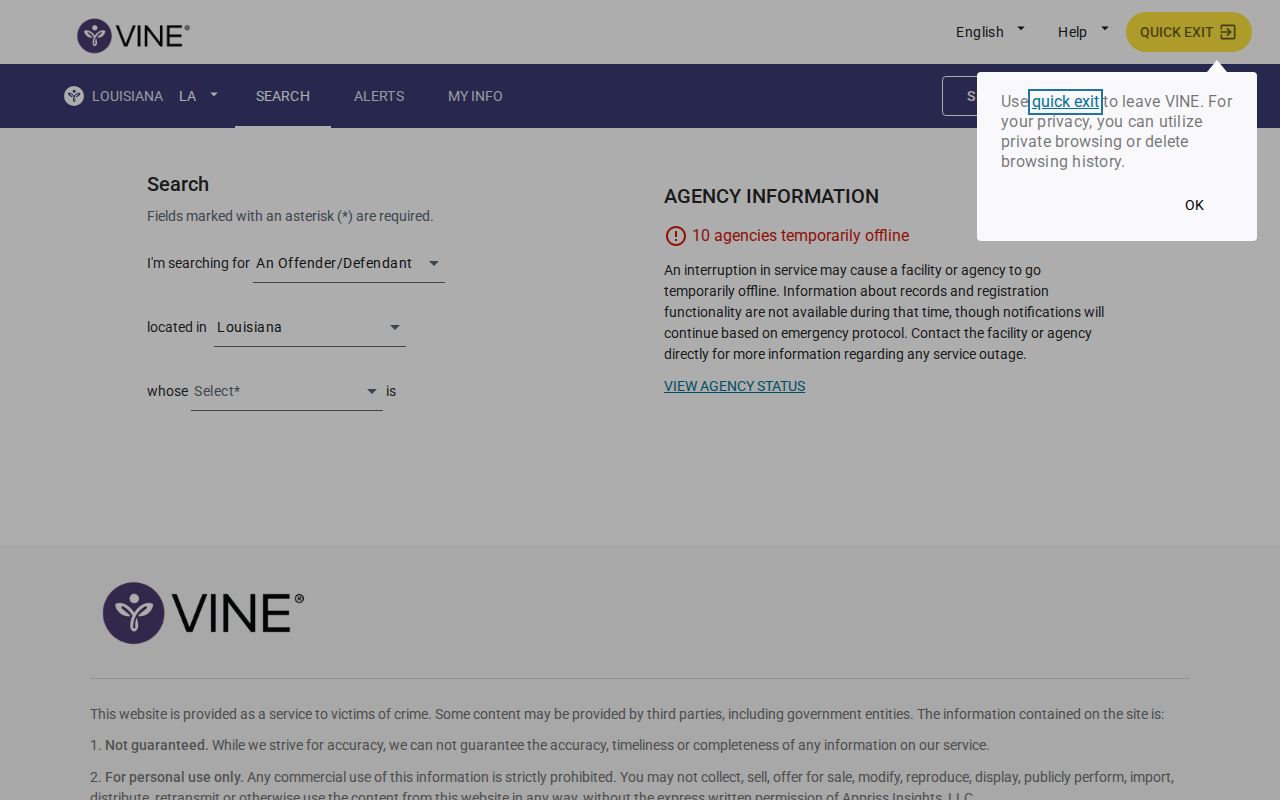
The screen starts the identity search; it is not itself a release record or proof of a custody change.
Search One Grant Parish Inmate
Use a name plus a stable identifier when possible. Name-only results can mix people, custody episodes, and agencies. A person may have an old Grant Parish booking, a later DPS&C sentence, and a federal matter. Keep those records separate.
- Open the Louisiana person search and select the person or custody search.
- Enter the full name. Add an ID or case number and location when those fields are available.
- Compare middle name, age or birth data, agency, facility, and case information across all matches.
- Open only the record tied to the correct Grant Parish or state custody episode.
- Read the status, location, reporting agency, update context, and offered notification events.
Record the date and time of the observation. Louisiana says its DPS&C-linked data update every 24 hours. If two sources disagree on the same day, the sheriff controls its booking record and DPS&C controls its state custody record. The Grant Parish released inmate search provides the broader fallback chain.
Grant Parish VINELink Result Fields
Available fields depend on the reporting agency. Do not rename a status or infer details the interface does not supply. A custody-change label speaks for the named agency only. It does not rule out a transfer, detainer, another jail, federal custody, or supervision.
| Field | What it can establish | Limit |
|---|---|---|
| Name or ID | Identity lead for the matched record | Must be checked against more than a photo or name |
| Agency or location | Which participant supplied the record | May change after transfer |
| Custody status | Agency-fed status at the update point | Not proof of freedom from every system |
| Notification choices | Events and channels supported for that record | Choices vary by agency and event |
| Projected release | A possible state calculation when applicable | Not the actual gate date |
A released result should be preserved with its agency and observation date. If the record says transfer, follow the receiving agency. If no match remains after full discharge, request the durable release or discharge record rather than calling the no-result proof.
Set Grant Parish Release Alerts
Registration starts from the correctly matched record. Select only the event options actually displayed. VINELink can support phone, email, text, in-app, or TTY channels depending on the agency. Contact details and PINs are private and should not be placed in screenshots or shared records.
- Open the matched person record and choose Register or Get Notifications.
- Select release, transfer, custody change, or other events that the record offers.
- Choose a supported channel and enter the required contact information.
- Complete the displayed verification. A phone registration commonly asks for a PIN.
- When an automated phone notice arrives, enter the PIN followed by the pound sign if instructed, then save the notice details.
Email or text registration may use a link or code. Interface steps can change, so follow the current prompts. VINELink lists 866-277-7477 for round-the-clock support in more than 200 languages when the service is not working.
Confirm Grant Parish Release Alerts
An alert is a prompt to verify, not a complete historical file. For a Grant Parish jail booking, call 318-627-3724 and request the booking and release entry. For a state case, use the DPS&C locator at 225-383-4580 with the DPS&C number or name and date of birth. For FCC Pollock, use the BOP Inmate Locator.
A registry is also different. Grant Parish OffenderWatch and the Louisiana State Police registry cover only qualifying registrants. They can show published registration or compliance information, but they are not a general released-person list and do not give the exact jail-door release time.
When the question concerns a court order, use the Grant Parish Clerk's signed minutes or judgment. A docket listing only shows a scheduled event. Each source should answer the part it owns.
Grant Parish LAVNS and LAVO
Louisiana maintains two notification layers that should not be collapsed. LAVNS/VINELink provides lookup and event registration for participating agency records. Louisiana Victim Outreach, or LAVO, is a separate DPS&C registration route for specified state-prison events.
LAVO covers notices such as projected release, actual release, sentence-length rulings, pardon or parole hearings, escape and apprehension, transitional-work assignment, release by any means, and death for eligible registered recipients. Local LAVNS registration does not automatically create a LAVO registration.
The official DPS&C Victim Services page explains the two layers, as captured below.
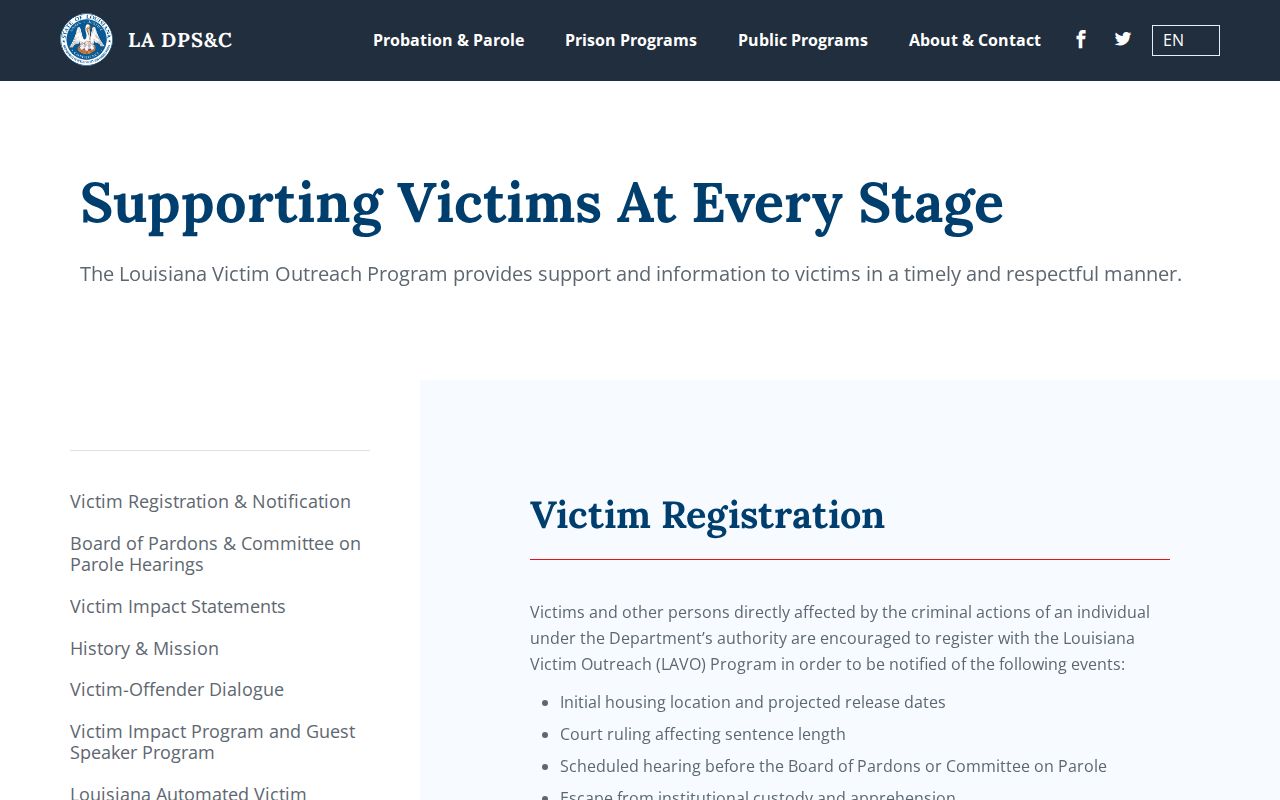
Use LAVO in addition to LAVNS for the listed state-prison notices, while relying on the matched Grant Parish record for county event options.
Missing Grant Parish VINELink Results
No result has several possible causes. The name may differ, the agency may not supply that event, the update may be pending, the person may have transferred, or a fully discharged record may no longer be public in that view. Expunged or confidential material may also be unavailable.
Recheck aliases, date of birth, ID, agency, and dates. Then use the correct authority. GPSO holds its jail booking record; DPS&C holds state custody and supervision data; BOP holds federal custody data; and the court holds the signed case outcome. A targeted request is stronger than searching every portal with only a name.
Do not use a photograph alone to resolve two similar names. Compare at least two reliable identifiers and keep each custody episode distinct.
Grant Parish Release Agency Boundaries
Grant Parish creates an unusual search problem because the parish jail and three federal institutions sit in the same parish. A GPSO record, a Louisiana VINELink result, and a BOP result can all contain local place names while describing different legal systems. Start with the agency that physically held the person during the episode in question.
For a Grant Parish Detention Facility booking, ask GPSO whether the booking ended and whether the record states community release or transfer. For a state sentence or community-supervision record, use DPS&C and LAVNS. For FCI Pollock, USP Pollock, or the federal prison camp, use BOP. VINELink does not become the federal locator merely because Pollock is in Grant Parish.
An immigration hold adds another boundary. A person may leave GPSO custody and enter ICE custody. The local release entry then proves only that GPSO stopped holding the person. Follow the receiving agency and preserve the exact transfer or hold wording.
Save Grant Parish Notification Details
When an alert arrives, save the event wording, reporting agency, date, time, and record identifier. Do not save or publish the registration PIN, private phone number, email address, or unrelated identity details. A concise event log makes later confirmation much easier when the live screen changes.
Compare the alert with the agency record that owns the event. If VINELink reports a Grant Parish custody change, call the detention facility and ask for the release or transfer entry. If it reports a DPS&C change, call the state locator or request the discharge record. If the alert concerns a hearing, obtain the final signed result rather than relying on the notice alone.
Dynamic records can change after observation. Wording such as “LAVNS displayed community supervision on the date checked” is more precise than an undated claim that the person remains on parole. That precision also prevents an old alert from being mistaken for current status.
Alert options may differ between two records from the same agency. Register only after identity matching, and do not assume that a missing release option means the person cannot be released. The interface shows the events supplied for that record at that time.
For a past event, ask for the durable record. GPSO can provide its booking and release entry through the documented records process. DPS&C can route a request for state release or discharge information. The court can supply the judgment or minute that explains the legal action behind the custody change.
A phone notice should be acknowledged only through the instructions in the current service. If repeated calls continue after a correct PIN entry, contact VINELink support rather than changing the event meaning. A technical registration problem does not establish that the custody record is wrong.
Release, transfer, escape, apprehension, hearing, and sentence events answer different questions. Select the event needed, then quote its actual label in personal notes. Do not turn a transfer notice into a claim that the person entered the community.
Grant Parish jail events and Louisiana state-prison events may use different choices. The matched agency record controls what can be selected. LAVO remains the separate route for its listed state-prison notices.
If a notification appears inconsistent with a direct agency response, note both timestamps and ask the reporting agency to reconcile them. The 24-hour update statement makes a brief mismatch possible. A dated agency release record remains stronger evidence of the completed event than an undated screen.
Keep the person search focused on one individual. Broad lists can hide identity errors, while a matched record with agency, ID, and custody episode gives the confirmation call a clear starting point.