
Grant Parish Projected Versus Actual
Louisiana DPS&C uses the exact phrase “projected release date (if applicable).” A projection is an agency calculation based on the sentence and current record. It is not an observed release event. The actual date is when the named authority's custody ended, as shown in its final release or discharge record.
A Grant Parish pretrial detainee often has no fixed date because bond, hearing outcomes, dismissal, or another order may control. A sentenced person may have a computed date, but the result still depends on the offense date, custody class, credits, exclusions, and holds. A federal date at FCC Pollock belongs to BOP.
Even an actual release label needs a boundary. Transfer from Grant Parish to DPS&C ends the parish booking but not confinement. Good-time release may start supervision. A BOP release date proves only that BOP custody ended.
Find Grant Parish Inmate Dates
The route follows the custodian. DPS&C's official locator instructions direct users to Louisiana VINELink and a phone locator. GPSO and the 35th Judicial District supply the parish booking, sentence, and order path.
- Identify Grant Parish jail, DPS&C, or BOP custody.
- For DPS&C, call 225-383-4580 with the DPS&C number, or name and date of birth, and request the projected release date if applicable.
- For a parish sentence, call 318-627-3724 and obtain the recorded calculation or release order. Compare it with the signed sentence.
- For a pretrial case, check the latest bond order and court minute instead of assuming a sentence date exists.
- After the date passes, obtain the final release record and check transfer or supervision.
The official locator wording appears in this DPS&C source capture.
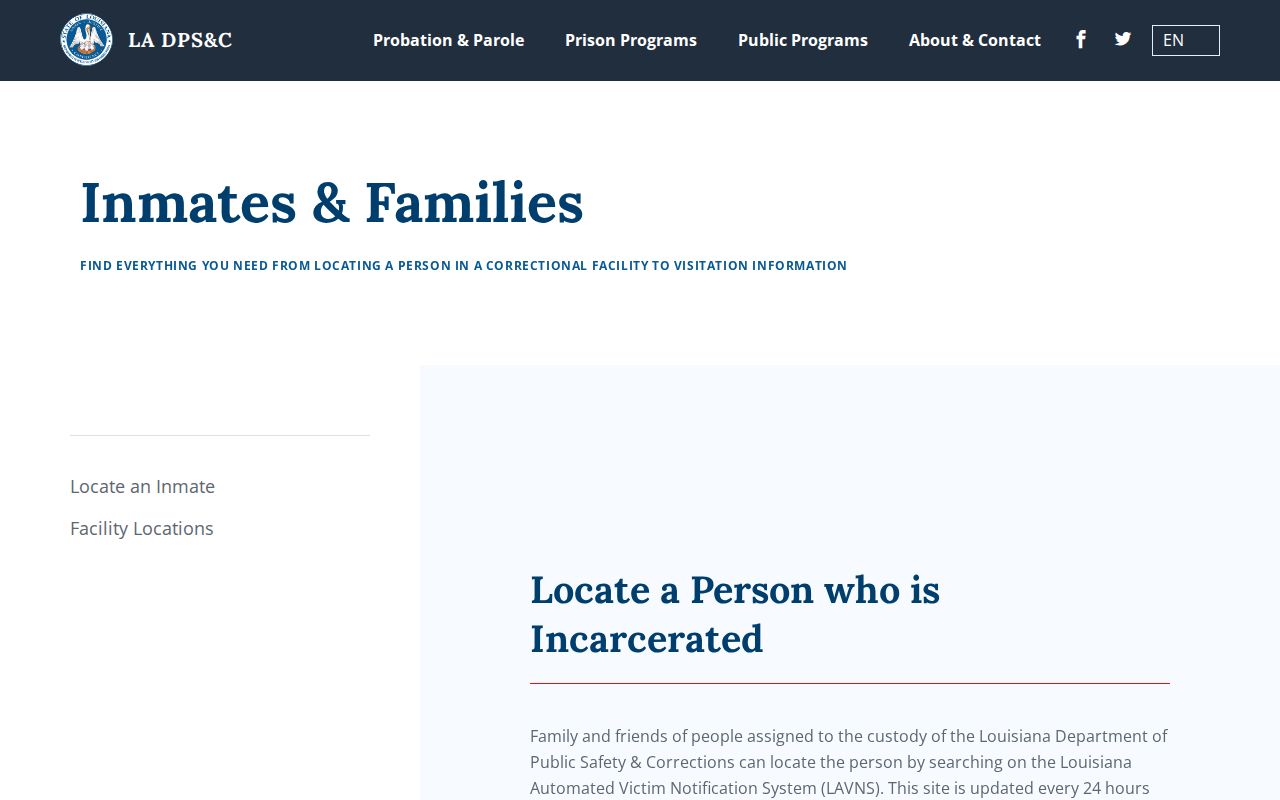
“If applicable” matters because not every custody record has a public projection.
Grant Parish Good-Time Date Rules
Good time is sentence credit authorized by law and applied by the responsible agency. For an offense on or after August 1, 2024, R.S. 15:571.3.1 allows a qualifying felony person in parish prison or DPS&C custody to earn up to 15 percent of the imposed sentence. It excludes defined sex offenses and habitual offenders, disallows good time on presentence credit, and permits forfeiture.
The maximum is often restated as serving at least 85 percent, but that headline cannot calculate one person's date. Eligibility, sentence structure, exclusions, presentence time, court corrections, and forfeiture still matter. Under the newer law, diminution release generally places the rest of the original term on unsupervised parole. A split sentence begins probation with that remainder.
For conduct before August 1, 2024, R.S. 15:571.3 remains relevant. A qualifying parish term without hard labor generally earns 30 days for each 30 served. A first crime of violence has a different rate. Certain DPS&C cases may use another ratio, and the statute contains broad exclusions.
Older diminution releases may be supervised like parole under R.S. 15:571.5. Do not apply the newer unsupervised rule to an older case without checking the effective date.
Why Grant Parish Dates Change
A date changes when facts in the official calculation change. Some events alter sentence math. Others prevent community release without changing the term. Ask which event affected the displayed date.
| Factor | Effect | Source |
|---|---|---|
| Credit earned or lost | Moves the projection | GPSO or DPS&C calculation |
| Court correction | Changes length, concurrency, or credit | Signed judgment |
| Consecutive term | Adds a term after another | Court and agency computation |
| Detainer or hold | Moves the person to another authority | Release and receiving records |
| Parole decision | May authorize release after processing | Board result and DPS&C |
| Administrative update | Corrects the agency calculation | Holding agency |
Presentence credit, program credit, and discipline can also matter. Never add calendar days to a sentence and call the result official.
Confirm Grant Parish Release Dates
The Grant Parish VINELink release check can provide state status and offered notices, but DPS&C says its data update every 24 hours. For a parish booking, ask GPSO for the release date, time, reason, authority, and transfer destination.
If a court order says time served but the person remains held, another case, warrant, detainer, or receiving authority may explain it. A parole grant also does not prove the gate opened that day. Match the legal event to the holding agency's timestamp.
Louisiana VINELink covers state custody and supervision. The BOP locator covers FCC Pollock. ICE uses its own locator. One system's released label cannot settle another system.
Grant Parish Jail Date Computation
GPSO does not publish a local good-time calculation policy, data table, or weekend and holiday release rule. The older Louisiana framework also assigns the sheriff a role for certain parish terms. A generic calculator is therefore unsafe.
Ask for the sentence used, offense date, hard-labor classification, presentence credit, governing rule, credits earned or lost, concurrent or consecutive treatment, and holds. Request the existing calculation or order instead of a custom forecast.
No official source shows that a Grant Parish date on a weekend moves to Friday or Monday. Families should call before travel. Exact release time, exit point, and waiting area also remain unverified.
Grant Parish Dates and Supervision
A custodial end date may begin parole, probation, or another supervision term. Newer good-time rules may create an unsupervised parole remainder, while older rules may place a person under supervision like parole. A split sentence can begin probation.
Alexandria District Probation and Parole serves Grant Parish. When the date record indicates supervision, confirm the assigned office and exact status there. Released from prison is narrower than finished with the sentence.
Discharge from incarceration, discharge from supervision, and full sentence expiration can be separate dates. Label each one precisely.
Grant Parish Sentence Date Records
The 35th Judicial District court record explains the legal basis for a parish release date. Search the Grant Parish Clerk file for the judgment, sentencing minutes, bond order, dismissal, probation order, revocation action, and later corrections. The public docket is only a schedule. It can change, and a listed event does not show that a judge signed an order.
For a sentence, confirm whether terms run at the same time or one after another. Concurrent terms run together; consecutive terms run in sequence. Confirm presentence credit and the custody authority responsible for applying it. A minute that says time served may authorize release, but GPSO still owns the physical departure timestamp.
When a date dispute turns on exact wording, obtain a certified or filed copy from the Clerk. Do not paraphrase a legal term into a different release type. “Bonded out,” “time served,” “sentence completed,” “transferred,” and “released to a hold” describe different events.
Grant Parish Transfer Release Dates
A parish release date may be the date GPSO transferred a person to DPS&C, another jail, a federal authority, or ICE. It is accurate to say the Grant Parish booking ended, but inaccurate to call that community release without evidence. Ask for the destination or receiving agency recorded in the release entry.
If DPS&C received the person, move to LAVNS and the state locator. If the receiving agency is federal, use BOP for a sentenced federal person and the federal docket or USMS record route for a pretrial detainee. If ICE is involved, use the immigration locator and the agency information line. Each system starts a new custody question.
A detainer is a hold or request from another authority. It may prevent a person from going home on the projected day even when the original sentence or local booking ends. The release date table should therefore be read with any hold and destination fields.
Match Grant Parish Date Records
A correct date attached to the wrong person or wrong booking is still a false result. Compare full name, middle name, date of birth or age, booking or DPS&C number, facility, case number, and arrest date. Use at least two strong identifiers when lawfully visible.
One person can have several Grant Parish bookings. Each has its own booking and release pair. A later state sentence may arise from one case while another parish case remains open. Keep a written timeline with source, observation date, custody authority, and exact status wording.
If two dates conflict, favor the source that owns that event. The court controls its order, GPSO controls the end of its booking, DPS&C controls its calculation and state discharge, and BOP controls federal custody. Ask the responsible office to explain or correct its record.
Note the observation date for any dynamic search. A projection seen today may be revised after a court filing, disciplinary entry, credit update, or hold. Preserve the exact field label and avoid substituting “tentative release date” when the Louisiana source says “projected release date.”
For an older event that no longer appears online, request the final record from the responsible custodian. A no-result is a gap, not proof that the person was released, never confined, or fully discharged.
Ask whether the date reflects the custodial term alone or the complete sentence. A state calculation may end incarceration while a parole or probation period continues. This distinction is especially important when a person appears in Louisiana community-supervision data after leaving a facility.
Do not combine dates from two case numbers. If the person has multiple matters, list each sentence, order, and custody episode separately. One open hold can delay departure even when another case has reached time served.
When speaking with an office, repeat the date and label back for confirmation. Ask whether it is projected, possible, scheduled, actual, transferred, or discharged. Those words should remain distinct in any later record note.
Save the name of the office, the date of contact, and the source record used. If the calculation changes, those details show which projection was current at each point and which agency should answer the next question.
A records request should identify the sentence or booking rather than ask for every record about a name. Include the approximate booking date and case number when known. That focus helps prevent an older Grant Parish release date from being attached to a newer case.
When the agency confirms a transfer, record the destination before starting the next search. The receiving authority, not the former jail, controls the next projected date and eventual release record.