
FPC Pollock Release Paths
Federal Prison Camp Pollock is the minimum-security satellite camp under USP Pollock. BOP operates both at FCC Pollock, and the handbook gives them the same Airbase Road address and phone. That relationship can make an abbreviated result difficult to read, but a camp placement is still a distinct federal custody setting. It is not a parish work-release program and should not be described as one.
A person may leave the camp for final release from BOP, a residential reentry center, home confinement administered within the applicable federal framework, another BOP facility, court-ordered supervised release, or custody accepted by another authority. Home confinement and RRC placement can involve substantial movement outside a secure prison while BOP responsibility continues. Neither should be converted automatically into a completed federal release.
| Camp departure | Record interpretation |
|---|---|
| Transfer to another BOP location | The institution changed, but federal custody continued. |
| RRC or transition placement | BOP transition responsibility may continue until the final date. |
| Past date with no BOP location | BOP custody ended, subject to supervision or other custody. |
| Release to another authority | The BOP episode ended without proof of community release. |
Check FPC Pollock Release Status
The BOP Inmate Locator is the public search for Federal Prison Camp Pollock. It covers federal inmate records from 1982 forward. Search with a BOP register number when possible. DCDC, FBI, and INS identifiers are also accepted. Without an identifier, use the full name and narrow with age, race, and sex only when those identity details are known from a sound source.
A match displays Name, Register Number, Age, Race, Sex, Release Date, and Location. The Location field separates an active placement from a past BOP result. A future date is projected and can change through agency recalculation. A past date and no facility location supports a completed BOP-custody finding, but BOP specifically warns that the person may still be under supervision or held by another system.
- Search the complete register number to reduce same-name errors.
- Confirm the person with more than a photograph or name alone.
- Read Location before deciding whether a move was a transfer.
- Read Release Date as projected when it remains in the future.
- Preserve BOP’s warning when reporting a past date or no-custody label.
FPC Pollock BOP Record
The official FCC Pollock page places the satellite camp within its correct federal institution family.
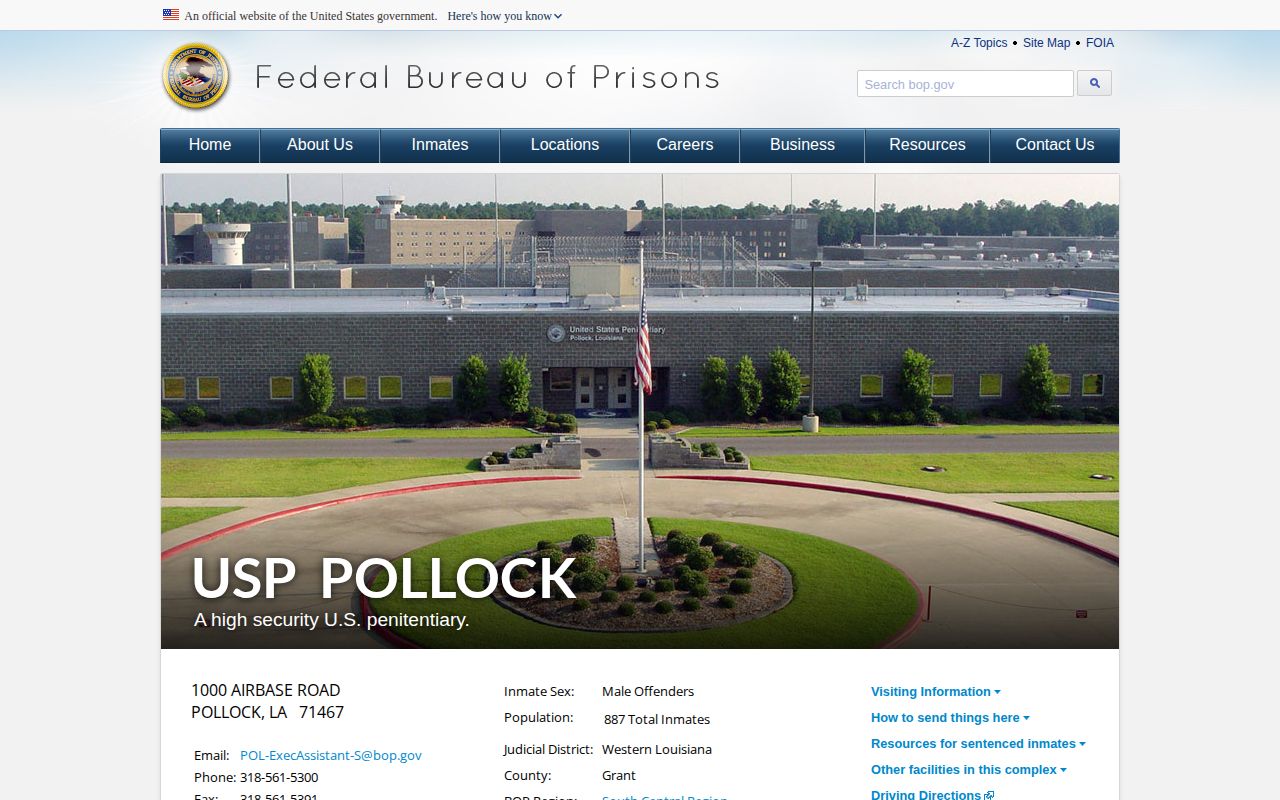
The federal source prevents the common error of treating the camp like a local Grant Parish jail or state corrections facility.
FPC Pollock Release Contact
The official FCC Pollock handbook lists 318-561-5300 for USP Pollock and the satellite camp. Both use 1000 Airbase Road, Pollock, LA 71467. The shared line reflects the camp’s administrative relationship with USP. FCI Pollock, the medium-security institution, uses 318-765-4400 instead. Use the correct phone so a camp question does not begin at the separate FCI.
Federal Prison Camp Pollock
1000 Airbase Road
Pollock, LA 71467
318-561-5300
Minimum-security satellite camp
Locator Route
BOP Inmate Locator
Identifier search preferred.
Release Date plus Location.
The institution line can route administrative questions, but the BOP locator is designed for the public custody-status search. A detailed or contested historical record may require BOP’s records process. The federal court docket supplies the legal orders. GPSO does not confirm routine camp releases and should not be contacted for that purpose.
FPC Pollock Transition Records
A lower-security placement often appears close to the end of a federal term, but security level alone does not establish a release date. The BOP field remains the public date source. A residential reentry center provides structured transition in the community and can appear as a BOP location. Home confinement may also keep the person within the federal sentence structure. Check the current BOP status rather than assuming the camp’s physical gate marks the end of federal responsibility.
After imprisonment, supervised release may begin under an order of the sentencing court. Supervised release is managed through the federal probation system. It is not Louisiana parole and does not belong in the state Alexandria Probation and Parole office. Read the federal judgment for the length and terms, and use later court filings for modification or revocation events.
The public locator does not promise a full narrative of each transition. If a result changes from the camp to an RRC or another federal location, record both the prior and current observation dates. The change supports movement within the federal system. It does not identify the precise transport time or prove that every sentence obligation ended. A formal BOP record or the court file may be needed when that distinction matters.
Future Release Dates may be recalculated. BOP points to the First Step Act as one reason displayed dates can change. Do not create an independent date by subtracting credits from the sentence. The agency calculation can depend on information not visible in a short locator result, and the sentencing court may issue an amended judgment. The current agency field is the sound public reference for the projected date.
- Satellite camp
- A minimum-security BOP facility administratively tied to USP Pollock.
- RRC
- A residential reentry center used for structured federal transition.
- Supervised release
- Community supervision imposed by the federal sentencing court.
- Transfer
- A change of custody location, not a community release.
FPC Pollock Release Proof
The strongest public BOP indicator of past release is a Release Date in the past with no current facility location. Preserve the exact record and observation date. Then use the federal court docket to distinguish the prison term from supervised release. The judgment may also show restitution, conditions, or later revocation proceedings, but a scheduled court event does not by itself prove physical release.
If another authority may have accepted custody, use that authority’s record. ICE ODLS can search with an exact nine-digit A-number and country of birth, or exact name and country of birth with an optional birth date. ICE’s limited recently released visibility is not a permanent archive. State and local holds require the receiving jail or corrections record. USMS FOIA and the federal docket are fallbacks for a former pretrial detention episode because the Marshals Service has no public name locator like BOP.
When sources disagree, give each agency its proper scope. BOP controls its custody result. The sentencing court controls its orders. A receiving agency controls what happened after transfer. No result should be stretched beyond the system that created it.
The date range also matters. The BOP locator covers federal inmates from 1982 forward. Records before that point may require archival research. For covered cases, search again with a verified identifier if a name produces no match. Middle-name variations and common names can lead to both missed results and false matches. The register number, case number, age, and institution provide a firmer identity chain.
For a former USMS detainee, the Marshals Service says its tracking system includes processing, placement, court, safekeeping, and disposition data. A FOIA request can seek an existing historical record, but it can involve exemptions and response time. It should not be described as a live release feed. Pair it with the federal docket and keep any conclusion tied to the episode those records identify.
BOP can also place a known death in the Date Released field. That classification must remain separate from a community release. Preserve the agency wording and confirm it through the proper record rather than using a general phrase such as “went home.”