
Grant Parish Parole or Probation
A person living in Grant Parish may be out of jail but still answer to Louisiana DPS&C community corrections. Parole means conditional community release within the sentence framework. Probation is part of a sentence imposed by the 35th Judicial District Court or another court. Both can involve reporting, conditions, and action after a violation. Neither status is proved by absence from the Grant Parish Detention Facility list.
The key is the source of authority. A parole record should connect to the Louisiana Board of Pardons and Committee on Parole, DPS&C custody data, or a diminution release rule. A probation record should connect to a signed court order and the clerk's case file. DPS&C administers community supervision for both, but that shared administration does not make the two terms interchangeable.
| Point | Parole | Probation |
|---|---|---|
| Legal source | Release within a prison sentence or a statutory good-time framework | A sentencing order entered by a court |
| Best record | Board result, DPS&C status, and release record | Judgment, probation order, and current DPS&C supervision record |
| Local route | Alexandria District Probation and Parole serves Grant Parish | |
| End point | Discharge or expiration under the controlling sentence | Court or agency record showing probation completed or terminated |
A sentence can also place probation alongside another form of release. Read the dates and exact labels. “Released from incarceration” does not always mean “discharged from supervision.”
Check Grant Parish Supervision Records
Begin with the identity and custody episode, not with a guess about status. Louisiana directs public name searches to LAVNS through VINELink. DPS&C says this system includes people assigned to state custody and people on probation or parole. It updates every 24 hours, so a fresh release or office transfer may not appear at once.
- Search the full name and add the known ID or case number when the interface permits. Compare age, middle name, agency, and case information before using a match.
- Read the agency-fed status and location. “Community supervision” supports a current DPS&C connection but may not by itself state whether the legal basis is parole or probation.
- For probation, obtain the latest signed judgment or probation order from the Grant Parish Clerk of Court. A court calendar is not a final order.
- For parole, search the Board's published result tied to the person and hearing date, then confirm actual custody departure and current supervision with DPS&C.
- Contact the Alexandria District office for neutral routing when the public record points to supervision but the assigned office or present status is unclear.
The full Grant Parish release-record chain is described on the Grant Parish released inmates search. That chain matters when a local jail release, a state transfer, and supervision begin close together.
Grant Parish Alexandria Supervision Office
Grant Parish does not have a published parish-specific Probation and Parole office. The Alexandria District office expressly serves Grant along with Avoyelles, Catahoula, Concordia, La Salle, and Rapides parishes. This regional structure is important. A Grant Parish address in a court file does not mean the supervising officer works from Colfax.
DPS&C Alexandria District Probation and Parole2800 South MacArthur Drive, Suite F
Alexandria, LA 71301
Phone: 318-487-5301
The office can route a status question when an authorized public record suggests supervision. Provide the person's correct name and any DPS&C or case number. If Alexandria says another district handles the case, follow that transfer. Do not treat reassignment to another Louisiana district or another state as discharge.
The manifest image below comes from the official Alexandria District listing.
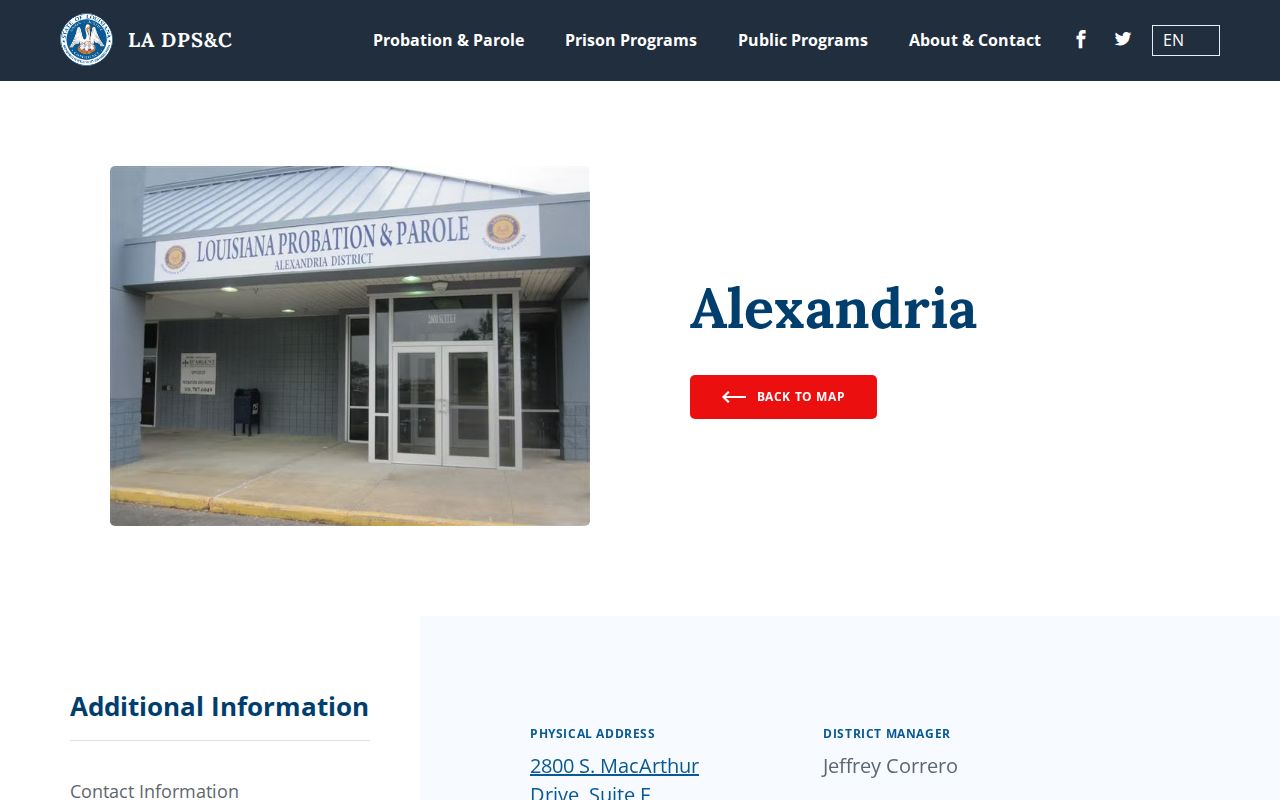
It supports the regional-office route for Grant Parish supervision questions, rather than a nonexistent parish office.
Grant Parish Violations and Absconders
DPS&C publishes a general parole condition requiring a person to report within 48 hours after release and to make a monthly report by the fifth. Those rules are broad statements, not proof of one person's appointment or compliance. The supervising officer and signed conditions control the individual case. Conditions may address reporting, movement, treatment, or other conduct stated in the official record.
An absconder is a person alleged to have stopped reporting or left supervision without authorization. That label should come from the supervising agency or a valid court record. No complete Grant Parish absconder list was verified. Likewise, a Board revocation calendar only shows a scheduled proceeding. It does not prove a warrant, a finding, present custody, or final revocation.
If a violation is alleged, compare the Alexandria office record, the issuing court, the Board's revocation schedules, and current agency-fed status. Ask which authority issued any warrant and whether it remains active. A person can be outside the local jail and still face supervision action.
- Absconder
- A person alleged to have stopped required contact with supervision.
- Revocation
- A formal process that may end community supervision and return a person to custody.
- Detainer
- A request or hold from another authority that may affect release.
- Discharge
- The documented end of a specified custody or supervision term.
When Grant Parish Supervision Ends
Supervision ends through an agency or court event, not through disappearance from a public result. For parole, preserve the discharge or sentence-expiration record that identifies the term ending. For probation, use the court minute, signed order, or DPS&C record that shows completion, early termination, revocation, or transfer. Specify what ended. Discharge from prison, discharge from community supervision, and expiration of the full sentence may occur on different dates.
A LAVNS no-result is not a permanent discharge certificate. DPS&C does not describe VINELink as a complete archive of everyone once held. If an older Grant Parish supervision entry no longer appears, request the relevant DPS&C discharge record and compare it with the Clerk's final case documents. Louisiana expungement can also remove eligible records from normal public access without destroying them.
Board eligibility and decision rules vary by offense date. Under current law, most DPS&C commitments for offenses on or after August 1, 2024 are not parole eligible except for narrow listed categories. Older cases can follow the detailed percentages and exclusions in the law. Eligibility only permits consideration. It does not prove a grant, a gate date, or supervision discharge.
Grant Parish Parole Hearing Records
The Board schedule publishes notice and agenda files in recurring hearing-week groups. An agenda establishes that a hearing was planned. It does not establish that the hearing occurred, that parole was granted, or that the person left custody. Match it to the Board result archive and then to DPS&C custody status.
The results archive provides hearing date, hearing location, year choices, and search. The safest general outcome words are “grant” and “deny,” based on the Board's own policy. If an entry uses continued, deferred, rescinded, or other wording, preserve that exact label. A grant still requires processing and conditions before physical release.
For an older offense, consult the detailed eligibility law rather than applying a single percentage. For a newer offense, start with the post-August 2024 restriction. A Board decision answers a legal question. The final DPS&C record answers whether and when custody changed.
Grant Parish Release Skills Programs
The Grant Parish Detention Center appears on the DPS&C Certified Treatment and Rehabilitation Program local-jail list. A local 2026 report also describes expanded education, certifications, and vocational work aimed at preparation for life after release. This is useful local reentry context, but it is not proof that a named person joined or completed a program.
A program record can help explain credits or transition planning only when the responsible agency connects it to the specific sentence. It cannot replace the official projected-date calculation or supervision order. Ask the facility or DPS&C for the person's own authorized record when participation affects a legal or records process.
Grant Parish supervision may connect a released person with required services. Those directions come from the officer and signed conditions. General program availability should never be turned into a claim about one person's needs, progress, or status.
Grant Parish Release IDs and Property
GPSO directs passports, birth certificates, Social Security cards, driver licenses, green cards, and similar official papers mailed to a detained person into the Business Office for safekeeping. The local jail audit separately marked return of property and identification at release as part of the checked process. These details matter because identification and case papers may be needed for reporting after release.
Before travel, the released person or an authorized helper should call the detention facility about any item believed to remain there. The audit describes the process observed during its review, not a promise about each later release. For an inaccurate covered publication, Louisiana R.S. 14:133.7 provides a no-cost dispute route with the publisher, but that correction process is separate from recovering property.
Keep receipts and agency records. They can show which office held an item and when it was returned. They do not establish parole compliance by themselves.