
FCI Pollock Release Paths
Federal Correctional Institution Pollock is the medium-security component of FCC Pollock. The Federal Bureau of Prisons operates it at 1000 Airbase Road in Pollock. A person leaving the FCI may enter the community at the end of BOP custody, move to supervised release, transfer to another BOP prison, move to the high-security USP or another part of the federal complex, or enter a residential reentry center. An RRC is a structured federal transition placement, often called a halfway house. Placement there is not the same as being free of federal responsibility.
A federal sentence can also end at BOP while another sovereign takes custody. A state or local warrant, an immigration hold, or another lawful detainer may prevent community release. For that reason, a page result must be described as release from BOP custody unless another official source proves where the person went next. FCI Pollock’s location in Grant Parish does not give the Grant Parish Sheriff authority over routine BOP releases.
| FCI record pattern | Careful reading |
|---|---|
| Future Release Date and FCI location | The displayed date is projected and the person remains in BOP custody. |
| New BOP location | A transfer occurred; do not call it a final release. |
| RRC location | Federal transition custody or placement continues. |
| Past date with no location | BOP custody ended on that date, subject to other custody or supervision. |
Search FCI Pollock Release Records
The BOP Inmate Locator is the correct public search for an FCI Pollock record. It covers federal inmates from 1982 to the present. Identifier searches accept a BOP register number, DCDC number, FBI number, or INS number. A name search accepts first, middle, and last name, with age, race, and sex available to narrow a match. A BOP register number is preferable because several people can share a name.
Read the whole result. BOP displays the name, register number, age, race, sex, Release Date, and Location. The capitalized “Release Date” is a BOP field, but its meaning depends on timing and location. BOP warns that future dates may change, including through recalculation under the First Step Act. It also explains that “Released” or “Not in BOP Custody” does not rule out parole, supervised release, or custody in another correctional system.
- Search the BOP register number first, retaining its full five-digit and three-digit format.
- If no number is known, search the complete name and narrow only with reliable identity details.
- Compare the register number, age, and other lawful identifiers before using the record.
- Read Release Date and Location together, and note when the result was observed.
- Check the federal court file when the sentence, revocation, or supervision terms need explanation.
FCI Pollock BOP Source
The official BOP institution page identifies the federal complex and supplies the agency-controlled institution route.
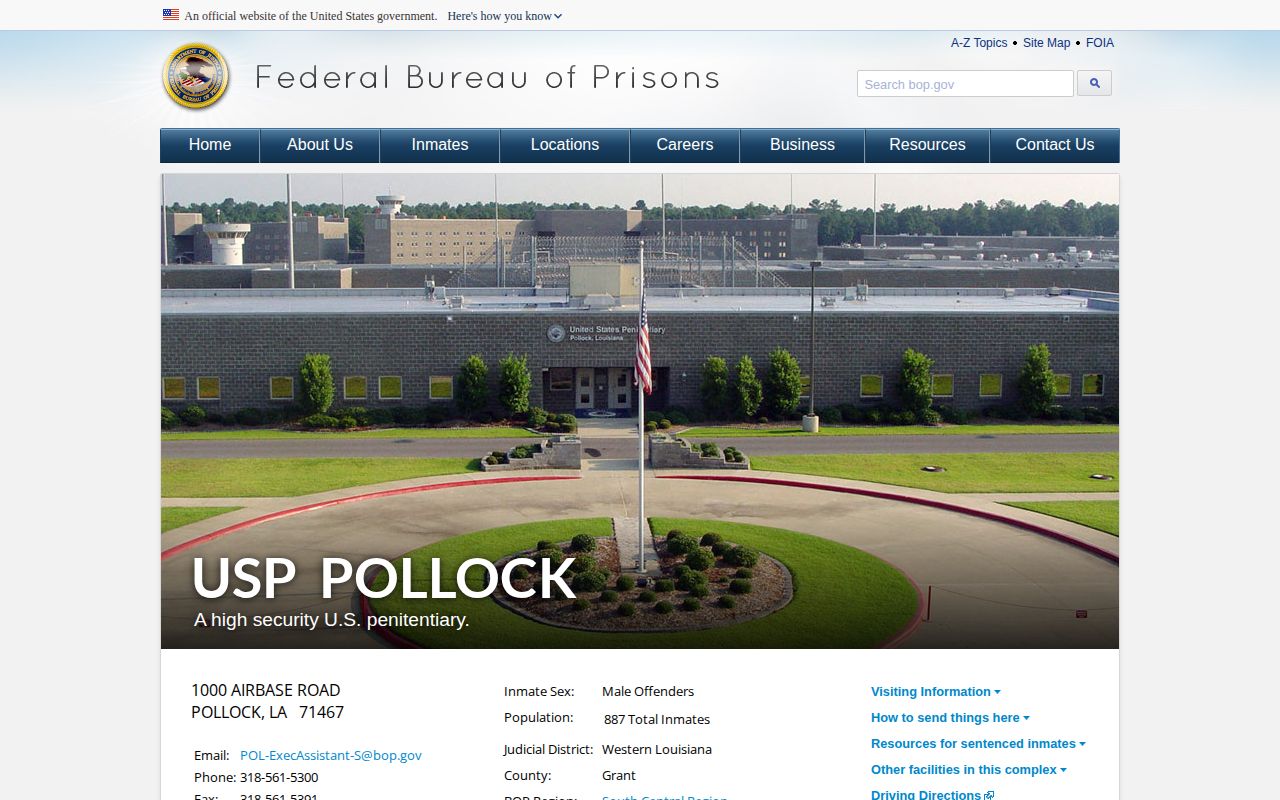
This source keeps the medium-security FCI within its proper federal setting and separates it from the parish detention facility in Colfax.
FCI Pollock Release Contact
The official FCC Pollock handbook gives FCI Pollock a separate phone number from the USP and satellite camp. Use 318-765-4400 for the FCI at 1000 Airbase Road, Pollock, LA 71467. That distinction is material. The USP and camp share a different published line, even though all three institutions use the federal complex address.
FCI Pollock
1000 Airbase Road
Pollock, LA 71467
318-765-4400
Federal Bureau of Prisons
Public Search
BOP Inmate Locator
Use a register number when known.
Check Release Date with Location.
Facility staff can route an institution question, but the public locator remains the first release-status channel. If the locator has a disputed historical entry, use BOP records procedures and the federal case docket. Do not call GPSO merely because the FCI lies within Grant Parish.
FCI Pollock Federal Records
The BOP result is a concise locator record, not the full legal history. The federal district court docket holds the judgment, amended judgment, sentencing filings, and any later supervised-release or revocation orders. Supervised release is a court-imposed period in the community after imprisonment, overseen through the federal probation system. It is not Louisiana parole and should not be checked through the Alexandria state probation office.
A former federal pretrial detainee may instead have been held under the U.S. Marshals Service before sentence or designation. USMS has no comparable public name locator. Its Freedom of Information Act route is the records fallback, and its Prisoner Tracking System is described as containing identity, court, processing, placement, safekeeping, and disposition data. FOIA is not an instant status check, and exemptions or processing time may apply.
Keep each federal episode separate. A person can have an earlier local booking and a later federal sentence. The date from one cannot be attached to the other because the names match. Search by register number and federal case number wherever possible.
BOP records begin in the public locator with 1982 coverage. An older federal confinement may require an archival route instead of repeated name searches. Even within covered years, a changed name, incomplete middle name, or wrong identifier can hide a match. Recheck the register number against the judgment or another official federal record. Do not use a photograph alone to bridge identity gaps.
When the locator and court docket appear to conflict, compare what each source controls. BOP controls the current federal custody location and its calculation. The court controls the judgment and signed orders. A newly filed order may precede physical processing, while a future BOP date can be recalculated after an amendment. Preserve both observation dates and avoid solving the difference through independent sentence arithmetic.
A request about the actual exit should remain narrow. Ask whether BOP custody ended, whether a transfer occurred, or which public record contains the final agency disposition. Do not assume staff can disclose protected case, medical, or security information. A locator result is intentionally limited, and a FOIA response can redact exempt material. Those limits do not make a parish record the proper substitute.
After an FCI Pollock Release
A past BOP release date with no listed facility is strong public evidence that BOP custody ended on that date. It does not state the complete destination. The federal docket may show supervised-release conditions. An RRC record can show a transition placement before the final date. If immigration custody is plausible, ICE’s Online Detainee Locator uses either a nine-digit A-number plus country of birth or exact biographical details. Recently released ICE records can remain visible for a limited period, but exclusions and lag make absence inconclusive.
A known state or local hold requires the receiving agency’s record. Ask which authority accepted custody rather than labeling the move a community release. If no result appears anywhere, recheck spelling, identifiers, date coverage, and the actual institution. A no-result remains an evidence gap. It is never affirmative proof that no confinement occurred.
A federal release also should not be confused with the end of the whole sentence. Supervised release can follow imprisonment and may later generate modification or revocation filings. For older federal cases, parole can appear instead. Describe the observed event precisely, such as “released from BOP custody,” then look to the federal court and supervision records for the remaining legal status.
Death requires equally exact wording. BOP notes that a known death can appear in the Date Released field. If that label appears, retain the official classification and confirm it through appropriate records. Do not describe that custody-ending event as a return home or a community release.