
USP Pollock Release Outcomes
United States Penitentiary Pollock is the high-security institution within FCC Pollock. BOP operates it at 1000 Airbase Road. A person can leave the USP through several paths. Final BOP custody may end at the sentence date. The person may move to supervised release in the community, enter a residential reentry center, transfer to another BOP prison, move to a lower-security component, or pass to a state, local, or immigration authority under a valid hold.
Security level is a facility fact, not proof of how a specific case ends. The court’s judgment and BOP calculation control the federal sentence. A transfer from the penitentiary to FCI Pollock or the satellite camp can reflect a change of placement while the person remains in BOP custody. Likewise, a move to an RRC is a federal transition stage. It should not be labeled a complete release merely because the person is no longer at the USP.
| Where the person goes | What the event means |
|---|---|
| Another BOP institution | Federal custody continues under a new location. |
| Residential reentry center | Structured federal transition placement continues. |
| Community supervision | Imprisonment ended, but court-ordered supervised release may remain. |
| Another authority | BOP custody ended while state, local, or immigration custody began. |
Verify USP Pollock Release Status
Search the BOP Inmate Locator by register number whenever that number is available. The public service accepts a BOP register, DCDC, FBI, or INS number. A biographical search uses the first, middle, and last name with optional age, race, and sex filters. Name-only matches are risky. Compare at least two reliable identifiers, such as register number and age, before treating a result as the correct USP Pollock record.
The result displays Name, Register Number, Age, Race, Sex, Release Date, and Location. A future Release Date remains projected and may change through sentence recalculation, including changes associated with the First Step Act. A current location at another federal institution means transfer, not release. A past date with no location supports the narrower conclusion that BOP custody ended on the displayed date.
- Enter the federal register number in its complete format when known.
- Use name filters only to narrow, not to replace a sound identity match.
- Open the record and compare Release Date with the listed Location.
- Record the observation date because a dynamic result can change.
- Use the federal docket to explain sentencing or supervised-release events.
USP Pollock Locator Record
The official BOP locator is the public route for a person formerly housed at USP Pollock.
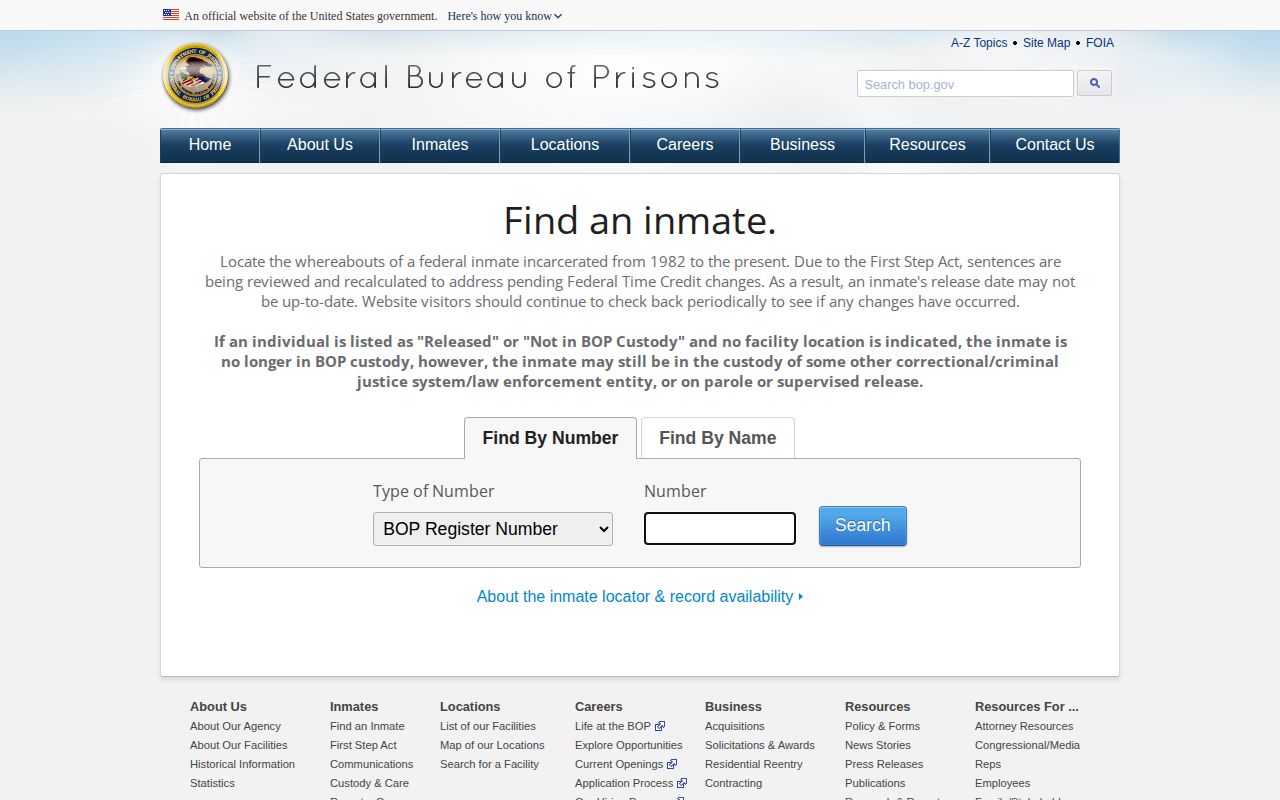
The locator’s federal fields and caution should remain attached to any conclusion drawn from the displayed release date.
USP Pollock Release Contact
The current FCC Pollock handbook lists 318-561-5300 for USP Pollock and its satellite camp. The address is 1000 Airbase Road, Pollock, LA 71467. FCI Pollock has a separate number, which helps prevent a question about the high-security penitentiary from being routed to the medium-security institution. The shared USP and camp line also reflects their institutional relationship, but the two remain different security settings.
USP Pollock
1000 Airbase Road
Pollock, LA 71467
318-561-5300
High-security federal penitentiary
Federal Search
BOP Inmate Locator
Prefer the register number.
Read date with location.
Use the phone for institution routing rather than asking staff to interpret a complete federal case history. The BOP locator answers the public custody-status question. The federal court file answers what sentence or supervision order was imposed. A formal BOP records request is the better route for a missing or disputed historical agency record.
USP Pollock Court Records
A BOP release result is not a substitute for the judgment. Search the relevant federal district court docket for the sentencing judgment, later amendment, and any revocation order. Supervised release is a court-ordered period after prison, administered through federal probation. It differs from Louisiana parole and from probation handled by Louisiana DPS&C. Grant Parish geography does not convert a federal supervision term into a state one.
A favorable court order may authorize release before administrative processing is complete. Conversely, a completed prison term may be followed by another hold. Compare the court action with BOP’s actual status. If the individual was a federal pretrial detainee rather than a sentenced BOP prisoner, USMS records and the federal docket may be more useful than a Pollock institution search. The U.S. Marshals Service has no general public name locator.
The locator’s 1982 start date is another boundary. A person with an older federal record may require an archival search. For a later case, verify the register number against the judgment or another official document before accepting a name match. Ages change, names collide, and the same person can have local and federal episodes. Keep the docket number, register number, facility, and observed date together.
USMS describes its Prisoner Tracking System as holding identification, court, processing, placement, safekeeping, and disposition data. Those records may help with a pretrial movement or a person held for court without a completed BOP prison designation. The FOIA route can take time and may involve exemptions. It is a historical records method, not a replacement for an urgent custody inquiry.
- Judgment
- The court’s sentence and supervision terms.
- Release Date
- The BOP field, projected when future and historical when past.
- Supervised release
- Federal community supervision imposed by the sentencing court.
- Detainer
- A request or authority that can lead to custody by another system.
Three Grant Release Authorities
Grant Parish contains the local detention facility and all three FCC Pollock institutions. The resulting search problem is distinctive. A GPSO result concerns the parish booking system. Louisiana VINELink concerns Louisiana custody or supervision where participating records are supplied. The BOP result concerns federal custody. “Pollock” ordinarily points toward BOP, while “Richardson Drive” points toward the sheriff.
Do not use a sheriff app disappearance as proof of release from USP Pollock. Do not use a Louisiana DPS&C no-result to infer that a federal term ended. Similarly, a past BOP record says nothing about a later parish booking. The Grant Parish released-inmate search path separates these sources when the agency is not known.
FCC Pollock’s three institutions also require care. USP is high security. FCI is medium security. The camp is minimum security and is under USP Pollock. A person’s movement among them remains a federal placement event unless the BOP record shows that custody ended.
After USP Pollock Release
If the BOP date is past and no federal location appears, check whether the court imposed supervised release. When another-custody concern is supported, follow the named authority. ICE’s locator accepts a nine-digit A-number with country of birth or exact biographical information. ICE states that some released records remain visible for 60 days, but age exclusions, discretionary omissions, spelling, and processing lag can produce no result. Its absence is not proof.
For a state or local hold, request the receiving agency’s custody entry. For a disputed USMS episode, use the federal docket and the Marshals Service FOIA route. Keep the conclusion narrow: “BOP custody ended,” “transferred within BOP,” or “released to another authority.” These phrases convey what the source can prove without turning a system-specific result into a claim about every possible form of custody.
Future dates deserve the same restraint. BOP says release dates may be recalculated under the First Step Act. Court amendments, agency calculations, and other lawful changes can alter the displayed field. Do not calculate a replacement date from a sentence length or assume the date seen earlier remains current. Record the date of the lookup and return to the agency result when timing matters.
If BOP and the federal docket seem out of step, ask what event each record reflects. A signed order can precede transport or processing. A location change can precede the ultimate release date. The court speaks to legal authority, while BOP speaks to the federal custody record. Neither GPSO nor Louisiana VINELink resolves that federal timing difference.
A known death must not be grouped with community releases. BOP explains that death can appear in the Date Released column. Preserve that label and seek appropriate confirming records rather than saying the person left for the community. The same care applies to transfer and detainer entries, since each ends or changes one custody placement without proving a return home.
No-result searches also need a disciplined response. Recheck the spelling, aliases, register number, age, and date range. Determine whether the event predates public BOP coverage or belongs to USMS pretrial custody. Absence from the locator is an unresolved gap, not evidence that the person was never held or has been released.